January 8, 2026 | News | SUNTV Global Channel
Security has been significantly tightened at the Kuje Medium Security Custodial Centre (MSCC) in Abuja following the deployment of over 50 operatives of the Department of State Services (DSS) amid an ongoing investigation into alleged terrorism financing involving former Attorney General of the Federation and Minister of Justice, Abubakar Malami.
Multiple security sources confirmed that the operatives began taking up strategic positions within and around the facility from Wednesday, describing the move as a pre-emptive security measure following Malami’s grant of bail by the Federal High Court in Abuja in his ₦8.7 billion money-laundering case.
According to a senior security source, the DSS presence is intended to ensure that Malami does not evade a separate and sensitive terrorism financing investigation, which, although not listed in the current charges against him, is reportedly still active.
“Since Wednesday, Kuje Prison has been heavily fortified by DSS operatives, numbering more than 50,” the source said.
“They are there to ensure that Malami does not escape or interfere with the ongoing terrorism financing investigation.”
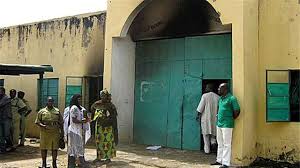
Sources described a tense atmosphere at the custodial centre as the secret police arrived in a convoy of approximately six Toyota Hilux vans, establishing a visible perimeter around the prison gates. All movements in and out of the facility are reportedly being subjected to heightened scrutiny.
“About six Hilux vans are stationed at the prison,” one source disclosed.
“The operatives are monitoring every entry and exit.”
On Wednesday, Justice Emeka Nwite of the Federal High Court granted Malami bail in the sum of ₦500 million, alongside two other defendants in the case. The bail conditions include the provision of two sureties who must own landed property in high-value Abuja districts such as Asokoro, Maitama, or Gwarinpa.
The court further ordered that all property documents be verified by the Deputy Chief Registrar, while the sureties are required to swear to affidavits of means. Malami was also directed to submit his international travel documents and barred from leaving Nigeria without prior approval of the court.
Malami, who served as Nigeria’s chief law officer for eight years, is currently standing trial alongside his son, Abdulaziz Malami, a Senior Advocate of Nigeria, and one of his wives, Bashir Asabe. The trio faces a 16-count charge filed by the Economic and Financial Crimes Commission (EFCC) over the alleged laundering of ₦8.7 billion.
He remains in custody at the Kuje Correctional Centre pending the perfection of his bail conditions.
Although terrorism financing does not feature in the current EFCC charges, sources say Malami has been under the radar of security agencies over alleged financial flows linked to insurgent activities.
In December, when the EFCC initially detained Malami, investigators reportedly examined issues relating to terrorism financing and the whereabouts of Abacha loot recovered from Switzerland and the Island of Jersey in the United Kingdom. However, those allegations were not included in the charges eventually filed.
In an exclusive interview in December 2025, retired Nigerian Army General Danjuma Ali-Keffi, who led a presidentially approved counter-terrorism operation known as Operation Service Wide (OSW), disclosed that high-profile Nigerians were linked to suspects arrested for terrorism financing.
Ali-Keffi, a former General Officer Commanding (GOC) of the 1 Division of the Nigerian Army, said OSW was established in 2021 to identify Boko Haram masterminds, trace their funding sources, and dismantle their networks.
According to him, the operation uncovered an extensive web of financiers allegedly connected to senior government officials, influential military officers, and major financial institutions.
Documents obtained during the investigation reportedly showed that OSW, working alongside the Nigerian Financial Intelligence Unit (NFIU), arrested several high-profile suspects in March 2021. The findings were later presented to then-President Muhammadu Buhari in September 2021.
Ali-Keffi stated that two suspects arrested during the operation were linked to former Chief of Army Staff Lt. Gen. Tukur Buratai (rtd), while two others were linked to former AGF Abubakar Malami. One suspect was allegedly linked to former Central Bank Governor Godwin Emefiele, while another was associated with former Army Chief Gen. Faruk Yahaya (rtd).
“I am not accusing Buratai, Malami, or Emefiele of terrorism financing,” Ali-Keffi clarified.
“But investigations linked them to some of the suspects. I don’t know if they were later cleared.”
Ali-Keffi further alleged that Malami interfered in the terrorism financing investigation by removing a senior prosecution lawyer who had refused to compromise on the sufficiency of evidence to prosecute 48 suspects.
He claimed pressure was later mounted to pursue money-laundering charges instead, a move he believed was intended to shift jurisdiction to the EFCC, which was under the supervision of the Attorney General at the time.
According to Ali-Keffi, his resistance allegedly led to reprisals, including detention, forced retirement, and continued persecution. He later wrote to the U.S. President, the U.K. Prime Minister, and European Union leaders, seeking international protection, citing threats to his life and that of his family.
A Case at a Critical Stage
With the DSS now maintaining a strong presence at Kuje Prison, sources say the terrorism financing investigation has reached a critical and sensitive stage, even as Malami battles money-laundering charges in court.
The developments underscore growing tensions within Nigeria’s security and judicial systems, as authorities navigate allegations involving some of the country’s most powerful former officials.