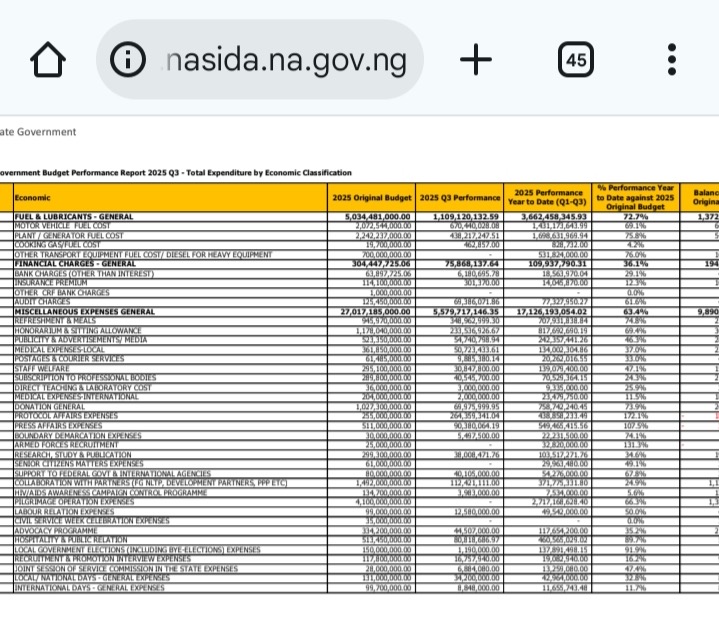
A review of Nasarawa State’s budget performance has ignited fresh controversy after it emerged that the state government spent N707 million on refreshments and meals within nine months, while funding for rural water supply lagged far behind.
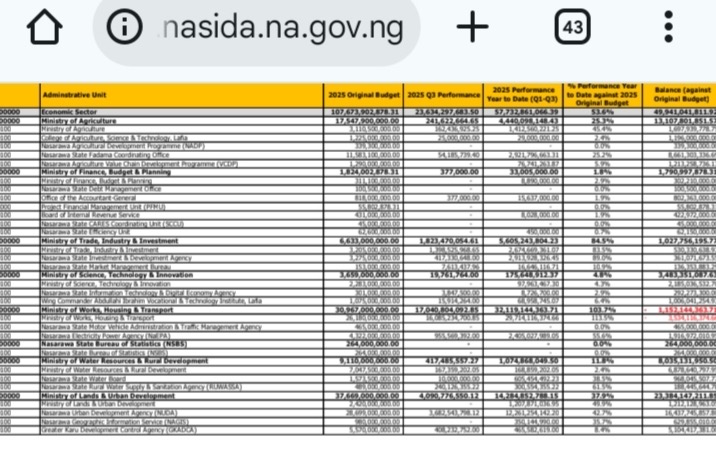
Findings from a SaharaReporters analysis of the state’s third-quarter 2025 budget performance show that between January and September 2025, spending on refreshments alone more than doubled the N300.5 million allocated to capital expenditure for the Rural Water Supply and Sanitation Agency, an essential sector responsible for providing clean and potable water to rural communities.
Across Nasarawa State, residents say the figures reflect their daily reality.
In Masaka, a resident described the struggle to access water as relentless, noting that even commercial water vendors are now finding it difficult to source water.
“We barely get clean water. Even those selling water in jerrycans complain that it’s becoming difficult to get water. Government promises have failed us,” the resident told SaharaReporters.
Similar frustrations were expressed in Karu, where residents say water scarcity has reached alarming levels.
“When you see any place where there is water, it feels like you’ve found gold. It is exhausting and frustrating,” another resident said.
The spending pattern aligns with earlier budget revelations. A previous review of the 2025 approved budget showed that the Nasarawa State Government allocated N2 billion for the extension and renovation of the State House of Assembly complex in Lafia.
A breakdown indicates that N1 billion was set aside for the extension of the Assembly office building, while another N1 billion was earmarked for renovation works.
In contrast, constituency projects—which include borehole repairs, primary healthcare centres (PHCs), and rural roads—were allocated N960 million, significantly less than the amount committed to the Assembly complex.
These constituency projects are intended to drive grassroots development through community-focused interventions championed by lawmakers.
Further analysis shows that while N2 billion was reserved for the Assembly complex, only N665 million was budgeted for the construction of three-block classroom buildings across the state.
Education experts argue that the amount earmarked for the Assembly could have funded at least three similar classroom projects, improving access to learning in underserved communities.
According to data from the National Bureau of Statistics (NBS) Multidimensional Poverty Index, 39% of school-age children in Nasarawa State lack access to education, highlighting the depth of the crisis.
Healthcare funding also trails behind legislative infrastructure spending. While N2 billion was allocated to the Assembly renovation and expansion, only N1.5 billion was budgeted for the construction of primary healthcare centres statewide. An additional N1.3 billion was set aside for PHC renovations, while N400 million was allocated to the Basic Healthcare Provision Fund (BHPF).
Growing Public Anger
Civil society groups and residents say the spending priorities reveal a disconnect between government decisions and the urgent needs of the people, particularly in water, health, and education.
As rural communities continue to grapple with water scarcity, critics argue that extravagant administrative spending—especially on refreshments—raises serious questions about governance, accountability, and commitment to basic public services in Nasarawa State.
SUNTV Global Channel will continue to monitor developments and hold authorities accountable.