February 10, 2026 | SUNTV Global Channel | Abuja
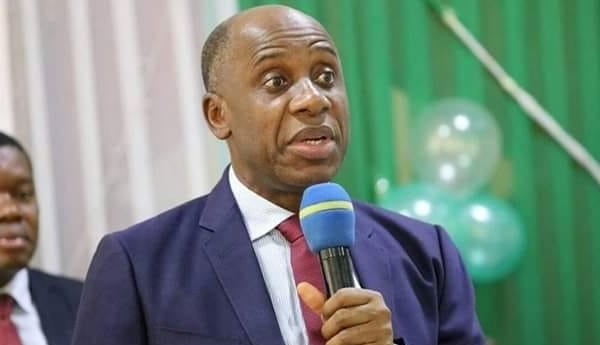
Public outrage over amendments to Nigeria’s Electoral Act intensified on Tuesday as former Minister of Transportation and ex–Rivers State Governor, Rotimi Amaechi, joined protesters at the National Assembly complex in Abuja.
Amaechi’s appearance marked the second day of mass demonstrations against the controversial removal of the clause mandating real-time electronic transmission of election results, a decision taken by the Godswill Akpabio-led Senate.
The protest, organised under the banner of the National Opposition Movement (NOM), drew hundreds of Nigerians demanding electoral transparency ahead of the 2027 general elections. Demonstrators carried placards calling for urgent reforms, while some openly demanded the resignation of Senate President Godswill Akpabio, accusing the National Assembly leadership of attempting to undermine democratic processes.
Tensions briefly escalated when Amaechi had a tense encounter with security operatives, as heavily armed personnel barricaded the main entrance of the National Assembly to prevent protesters from gaining access.
Security agencies deployed included the Nigeria Police Force, Nigerian Army, Department of State Services (DSS), Nigeria Security and Civil Defence Corps (NSCDC), and other allied agencies.
SUNTV Global Channel reports that the protest followed Monday’s demonstration led by former Labour Party presidential candidate, Peter Obi, whose presence further galvanised public resistance to the Electoral Act amendment.
Addressing the crowd at the National Assembly gate, Obi described the protest as lawful, patriotic, and necessary, thanking Nigerians for standing up for democracy.
“I want to thank the passionate Nigerians who have come out this morning to be part of this just demand for a free, transparent and fair election process,” Obi said.
“We must have a better Nigeria—one we can all be proud of.”
Obi disclosed that protesters were advised by security operatives not to move beyond the gates of the National Assembly, a directive he said was respected in the interest of peace.
Renewing calls for compulsory electronic transmission of election results from polling units, Obi argued that real-time transmission would curb manipulation and restore confidence in Nigeria’s electoral system.
“Election results must be transmitted electronically from the polling booth directly. Let people watch it,” he stated.
“This is what is done in South Africa, Ghana, and other countries. The giant of Africa has refused to be giant. We cannot continue to shame Africa.”
Meanwhile, mounting pressure forced the Senate to announce an emergency plenary session scheduled for Tuesday, February 10, 2026, to address widespread backlash over its handling of the Electoral Act Amendment Bill, 2026.
The emergency sitting was confirmed in a statement signed by the Clerk of the Senate, Emmanuel Odo, following days of condemnation from civil society groups, opposition politicians, labour unions, professional bodies, regional leaders, and a rapidly growing youth-led protest movement.
“The President of the Senate, Godswill Akpabio, has directed the reconvening of plenary for an emergency sitting on Tuesday, February 10, 2026,” the statement read.
Plenary is expected to commence at 12 noon, with all 105 senators expected to be in attendance as Nigerians watch closely for the outcome.