July 4, 2026
ABUJA, NIGERIA — Concerns over transparency in public spending have intensified after several Nigerian state governments were found to have either shut down or failed to maintain their Open Contracting Data Standard (OCDS) portals, preventing citizens from accessing information on government contracts and capital projects worth billions of naira.
The procurement portals were established under the World Bank-supported States Fiscal Transparency, Accountability and Sustainability (SFTAS) Programme to promote openness in public procurement and enable citizens to monitor contract awards, project costs, winning contractors, and procurement processes.
However, following the conclusion of the programme, many of the portals have become inaccessible or non-functional.
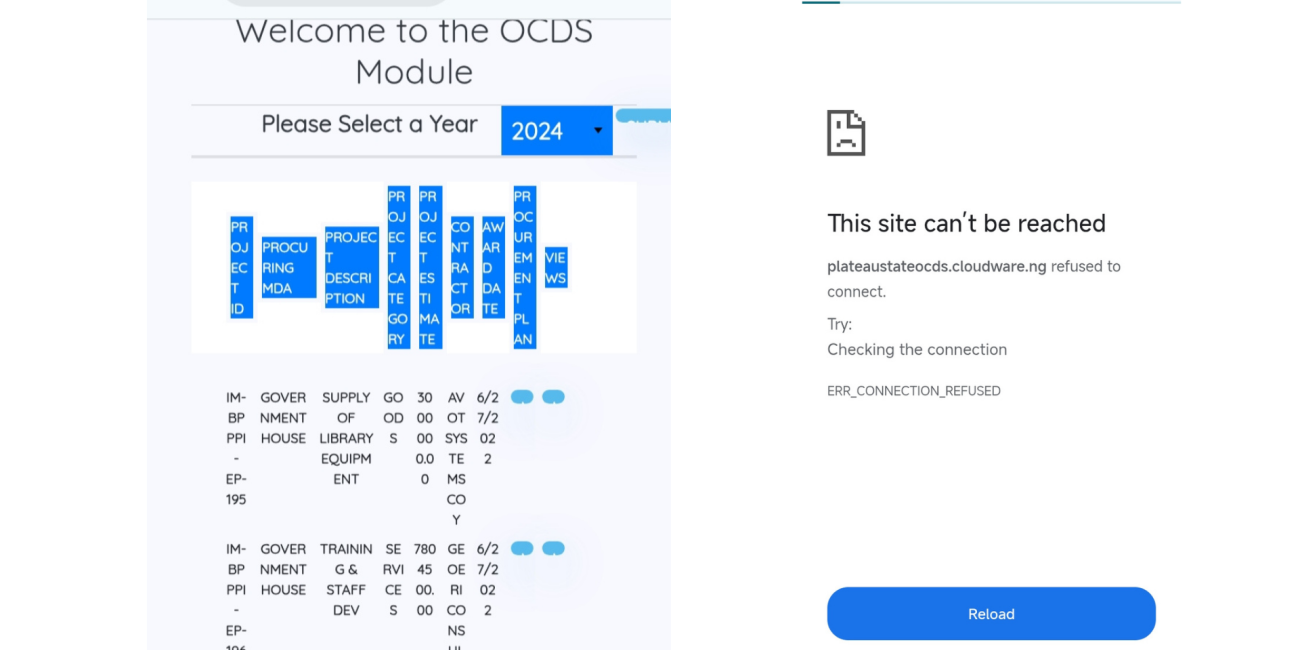
Checks revealed that Oyo State’s procurement portal currently displays an “Error establishing a database connection,” while Ondo State’s portal is also inaccessible. Kwara State’s portal is largely inactive, with only a landing page available. Similar issues were observed with procurement portals operated by Imo, Nasarawa, Plateau and Edo states.
The development comes despite the huge capital budgets approved by the affected states. Available records show that Oyo State spent about ₦394 billion on capital projects in 2025, Ondo State spent approximately ₦122 billion, while Kwara State recorded about ₦162 billion in capital expenditure during the same period.
The lack of functional procurement portals has raised fresh concerns about public accountability, as citizens and civil society groups are unable to independently verify contract awards, project execution, and government spending.
Past reviews of procurement records have also uncovered questionable contract awards. In one instance, a ₦1.4 billion contract in Ebonyi State was reportedly awarded to a company that had been registered with the Corporate Affairs Commission only weeks before securing the contract, even though the procurement process had begun before the company’s registration.
Transparency advocates say restoring the procurement portals is essential to ensuring public confidence, strengthening accountability, and allowing citizens to monitor how government funds are spent.